
New Micro Energy Grid on Sable Island
Sable Island Goes Greener: A Major Step Toward Sustainable Operations Yesterday, I attended an announcement by Parks Canada in Halifax about a $5.1 million


One of the final stops on all of our tours to Peggy’s Cove Visitors is an incredible granite sculpture located in what is Nova Scotia’s smallest provincial park. This is the Fishermen’s Monument, created by Finnish-Canadian artist William Edward deGarthe, whose life, art and legacy are intertwined into the rock of Peggy’s Cove.
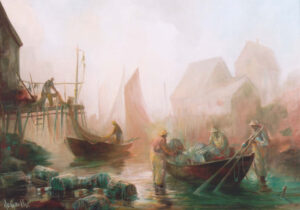 William deGarthe was born in Finland in 1907. After studying art and commercial design in Helsinki, he immigrated to Canada in the late 1920s, eventually settling in Toronto, Montreal and later Halifax. He and his wife Agnes came to Halifax originally to embark on a Caribbean cruise and they fell in love with a landscape that reminded him of his Nordic homeland, and so they eventually moved to Nova Scotia.
He began his career as a commercial illustrator and sign painter before turning to fine art. His paintings, often of maritime life and seascapes, captured the rugged landscapes and working people of the Atlantic coast. His style blended realism with impressionistic influence, focusing on atmosphere, movement, and light. Over the years, his work was exhibited across Canada and became well-known among collectors here in the Maritimes.

In the 1950s, deGarthe and Agnes purchased a small home in Peggy’s Cove after he had bought a fishing shack years before that he used as a studio on the edge of the Cove, with the Atlantic coastline and small fishing community became central to his work. The couple converted part of their home into a private gallery, where visitors could meet the artist, view his paintings, and purchase his work. Agnes played an essential role in welcoming guests and managing the business side of their gallery.

Then in 1977, at age 70, deGarthe began carving directly into the granite outcrop behind his home. Using mostly hand tools, he spent seven years creating 32 figures representing fishermen, their families, and guardian angels. He dedicated the work “to the people of Peggy’s Cove,” calling it the Fishermen’s Monument.
DeGarthe continued working on the sculpture until shortly before his death in 1983. His ashes were interred at the base of the monument, as he had requested, symbolically uniting him with the stone and landscape that inspired him.While his wife Agnes continued to live on the property and care for his legacy, William’s ashes are actually laid to rest inside the sculpture.
At first, I found this part of the story to be unbelievable, but it was eventually confirmed to me by two different Tourism Nova Scotia employees who work at Peggy’s Cove!
 After William’s death, Agnes deGarthe continued to operate the gallery and preserve the collection. Following her passing, the Province of Nova Scotia acquired the property, formalizing it as the William E. deGarthe Memorial Provincial Park – which is the smallest provincial park in NS!
The original gallery building, established by the deGarthes, was retained and is now operated seasonally as the William deGarthe Art Gallery under provincial management.
Today, visitors can explore both the Fishermen’s Monument and the William deGarthe Art Gallery at Peggy’s Cove. The sculpture is open to the public year-round, while the gallery operates seasonally and displays deGarthe’s original paintings and drawings.
A visit to the site offers insight into the life of one of Nova Scotia’s most unique artists — a man who carved his love for the people of Peggy’s Cove not just into canvas, but into the granite itself!

Sable Island Goes Greener: A Major Step Toward Sustainable Operations Yesterday, I attended an announcement by Parks Canada in Halifax about a $5.1 million

Learn the incredible story and detective work to find the lost meaning of the painted night’s sky above above the altar in Lunenburg, Nova Scotia’s

Created in collaboration with A For Adventure and Tourism Nova Scotia, we spent a day creating video and photography content showcasing our new Collision Course: